

When we decide to get in shape, we want to achieve our goals as quickly as possible. There are many methods to enhance our workouts, such as stair climbing. This post will analyze the advantages and benefits of this practice for transforming our bodies.
Do you want to know all the advantages of training by climbing stairs? Just keep reading to learn them
Obstacles and training

Many people run daily . It's a sport like any other. Running daily offers numerous health benefits. One problem that arises when running in the city is the lack of inclines for training. Running uphill increases our body's endurance and stamina. By subjecting our body to greater effort for a longer period, we pump more blood to the muscles, thus promoting their development. It also improves lung capacity.
If ramps aren't steep enough to provide resistance, stairs are a good alternative. The main advantage of stair climbing is that it integrates both aerobic power and plyometric training . It can be done in easily found, covered environments, in case the weather is bad. No equipment is needed, and it's completely free.
Benefits of training by climbing stairs
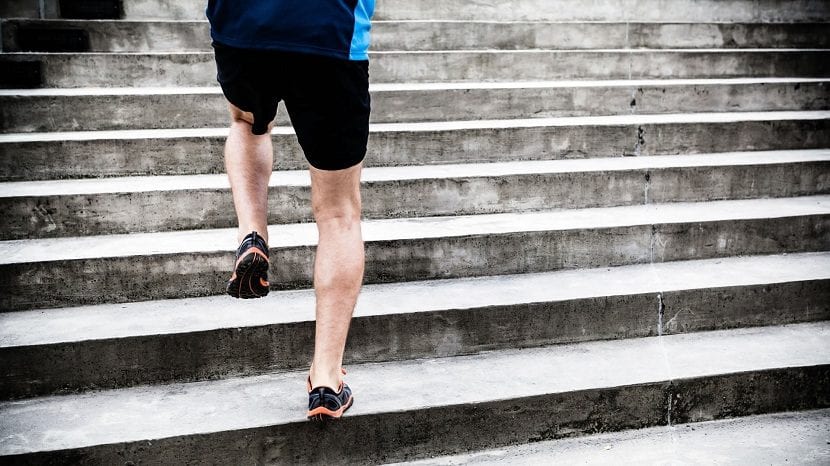
It is a training that can be done in different ways. Depending on the focus you want to give it, it has different types of intensities. It can be done in a more gentle way for the more initiated or more advanced. It is also a good option to do it at intervals to increase fat burning.
Broadly speaking, the main benefits obtained from this practice are:
- Muscle is improved through increased strength work. Any training needs strength work. During this work, different muscle contractions are carried out that give effect to the different types of movement. In running you should not work at maximum strength, but there should be a mixed work between strength and resistance to obtain more improvements and avoid possible injuries.
- Improves cardiovascular capacity. Carrying out a work maintained in the time and the suitable hardness, the cardiovascular system is being worked in each session. An easy way is to play with our pulse and recovery while we do the circuits. In this way we will be controlling the capacity we have to improve it.
- Improve running technique. If we want to achieve this, it is essential to carry out the work focusing very well on the position of the body at all times. We have to climb the stairs upright, do not skimp on raising the knees and use the sole of the foot and Achilles tendon and coordinate the movement of the legs with the arm movement exaggerating the gesture.
Variants of a workout

If the entire training program is performed correctly, it should not cause any injuries . On the contrary, it offers numerous benefits for our bodies and should help prevent such injuries. The key to this exercise is proper planning to follow the basic recommendations. It should not be practiced if you have tendon problems (especially the Achilles tendon). The difficulty should be increased gradually so that the body can progress without injury.
The steps should be descended one at a time, using the quadriceps to absorb the impact . Stair training includes numerous variations depending on the specific muscle group you want to work on. Let's look at different variations for the same workout.
Work force

We perform 3 sets, resting 5 minutes between each set . To descend the stairs, we walk slowly to recover to the starting position. Each set includes different exercises:
Climb 10 steps:
- To feet together without rest.
- To race.
- In soft foot (5 with the left and 5 with the right).
- Standing together, jumping two by two (5 jumps in total).
- To race.
- Feet together, jumping two by two stopping in a semi-flexed position for 2 seconds.
Resistance work
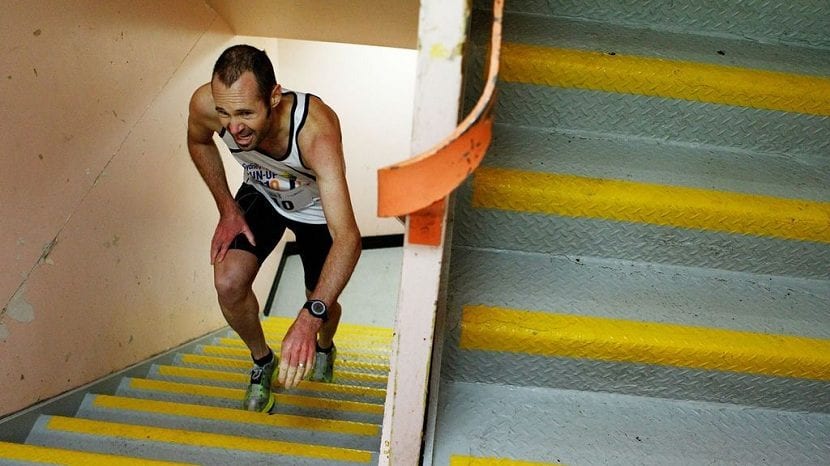
For this exercise, it's important to find the longest staircase possible. This way, we can maximize our effort. In this case, we'll do four sets of four minutes each, alternating quick ascents of about 25 or 30 steps with a return to the starting point at a jog. One ascent will be a run, another will involve jumping with both feet together, and another will be a hop. The recovery period between these sets will be three minutes.
The variants of ladder training are limitless. It depends a lot on the capacity of each one, the place where you live and the stairs you can access. If desired, small sprints can be introduced to finish every 2 or 3 climbs.
Who is this type of exercise for?
Anyone can do this type of training. The only requirement is to adapt the efforts to the initial capacities of each person and to follow the recommendations of the coach. It is necessary to pay special attention not to have discomfort or old injuries in the knees or in the Achilles heel due to being overweight. It is a modality that every practitioner of this discipline should do to improve and progress.
Many people, after gaining muscle mass during a bulking phase, choose to train by climbing stairs as a cardiovascular exercise during their cutting phase. To avoid losing the muscle gained, they shorten the time it takes to ascend and descend, but decrease the rest periods. This way, after a weight training session of at least one hour, fat will be used as energy reserves. A high-protein diet can help maintain the maximum muscle mass gained in the previous phase and prevent potential losses.
As you can see, these exercises are variants so that the body is continually in effort and becomes more efficient. With this we will gain in health and our body will thank us in the long run. If you can't find a place with stairs, you can always go to a soccer field and climb the stairs to the bleachers. Have you ever tried this training modality?